Showing posts with label Naomi Beth Wakan. Show all posts

Tuesday, 24 December 2019

A Christmas Story by Naomi Beth Wakan


A few words first, in order to give a setting to my small Christmas story. I, a non-observing Jew and a retired Toronto therapist, bought, with my husband Eli, a country school-house in the small village of Stirling, Ontario. We were totally alien to country life and, indeed, since we purchased the schoolhouse in late winter, did not even know whether the schoolyard, under deep snow at the time of purchase, was asphalt, or grass. We just saw the swings, the roundabout, the see-saw, the large schoolroom with a blackboard running down one wall and we were immediately seduced into buying a building totally inadequately insulated for an Ontario winter, and totally unsuited to residential life.

We also were uncertain as to what we might be doing in order to pay the schoolhouse’s ridiculously high-rate mortgage, but what we did know was that somehow we wanted to experience life in a village, and, for that, we were soon to discover, we would have to go to church. As recent Buddhist drop-outs and keen non-observers, we were reluctant to take this step, but the lure of singing in the small church choir overcame our resistance, and soon, each Sunday, we were to be seen donning black gowns with odd gold-drapery collars and belting out “Nearer my God to thee,” “Eternal Father strong to save” and other such oldies and goldies.

We had taken up residence in the schoolhouse in the summer and that Fall our little choir was busy practicing carols for the Christmas services. I was an amazingly keen participant in all this, perhaps because, as a young girl, I had been excluded from Christian assembly every day for six years at the girls’ high school that I attended. As one of a handful of Jewish students, I was only allowed into assembly after the Christian prayers had been sung, so that I might hear the notices of the day. In the line-up of girls slinking in belatedly (besides the Jewish ones) were the girls who had been given a detention or had been caught fraternizing in the local GI camp. Now, in my little village, at last I was being allowed to be party to the Christian mysteries.

I can barely remember, but think “Hark the Herald Angels”, “In the Bleak Mid-winter” and “Silent Night” were certainly among the carols the choir practiced.

Come the Sunday service before the holidays, a day selected for the choir to perform in all their black and gold glory, the snow descended as only the snow can descend in an Ontario winter. By the time Eli and I had donned, sweaters, trousers, boots, jackets, scarves and gloves, the snow was almost to our knees. The phone lines were down, of course, and our pump had ceased to function making us a little ashamed that we were going to church unwashed, but hoped we would be forgiven by he/she who forgives all.

The little church perched on the top of a hill from our schoolhouse, and it seemed to bob up and down as we dragged first one boot, then the other out of the deep snow. It was a good ten minutes of slogging that usually short climb, before we carefully pulled ourselves up the steps of the church.

It was surprisingly cozy inside. The farmer’s wife from the farm adjoining the church volunteered to come in and keep the place dusted, stoke the furnace, arrange seasonal flowers, play the organ and, in fact, do everything save give the sermon. She greeted us rather abruptly with the news that the service was cancelled as the minister couldn’t make it over from his lodgings in a nearby village, since the snow ploughs weren’t out yet. She doubted that any parishioners would turn up and seemed about to usher us out.

I, however, a new and devoted country woman, and almost as devoted choir member, was not about to be dismissed so abruptly. I had promised to perform and to perform I would, audience, or no audience. I should mention here that a few of my aunts had vague theatrical connections (one of them played piano to accompany silent movies) and my grandfather’s cousin had a gypsy orchestra so my showbiz roots weren’t too far away and “the show must go on” was somewhere engraved on my skeleton.

Persuasive as I can be when I want something to happen, I ushered her over to the organ to prepare, while Eli and I slipped into our gold and black horrors. She and I had a slightly heated un-Christian conversation about what we would sing to the non-existent congregation. For some reason, although the choir hadn’t chosen to include it in their program as it wasn’t Christmasy, I suddenly had a strong desire to sing “The Church in the Wildwood.” The farmer’s wife was taken aback and refused my earnest pleas, saying that it wasn’t in the United Church songbook. I turned aside, sulking a bit, and muttered the words to myself:

“Come to the church by the wildwood. Oh, come to the church in the vale. No spot is so dear to my childhood as the little brown church in the vale.”

I had no idea where this desire of mine to sing “Church in the Wildwood” had arisen from since I was brought up in the honky-tonk seaside town of Blackpool, nowhere near any vale, or dale come to that.

I halted my mumbling suddenly, remembering that this was supposed to be the season of goodwill, so I agreed with the farmer’s wife, and also with Eli (who had disloyally sided with her), in the decision that we would stay with “Hark the Herald Angels,” “In the Bleak Mid-winter”, and “Silent Night.” Eli and I proceeded to render them best as we could; although neither of us could get anywhere near the high note towards the end of “Silent Night.” The hollow church echoed our voices, bouncing them from stained-glass window to stained glass window.

As the word “peace” did its final echoing, I found myself moving towards the pulpit and, standing there, I started to give thanks. I thanked the empty pews for welcoming us to their village, and I thanked them again for allowing us to sing in their choir, and buy their farm milk and eggs, and shop for other basics at the little village store. And looking out over the ghostly empty church, I found myself thanking God for my sturdy body, imaginative brain and the good life I had been given. And I, a Jew, whose grandparents had never spoken English, at least not in a way that made any sense to me, and someone who had no idea what the word “God” meant, suddenly found the tears running down my cheeks at the joy of being able to share this moment with my dear husband and the farmer’s wife.

And looking over to my favourite stained-glass window, a window in which Jesus was carrying a new born lamb, it seemed to me as if he too nodded towards me in some kind of union.
She and her husband moved to Gabriola in 1996 and opened a studio, Drumbeg House Studio, where Elias makes wood sculpture and Naomi painted, wrote and did fabric art. During this period Naomi moved from writing books geared to children to books for an adult market. She did five books of poetry and essays for Wolsak and Wynn (Segues, Composition, Late Bloomer, Book Ends and A Roller-coaster Ride).

(first posted on this site December 27, 2018)

Monday, 28 January 2019

Trilogy of Japanese Short Form Poetry Now Available for the Human Soul

From Naomi Wakan:
I’m delighted to let you know that my trilogy of books on Japanese short-form poetry is now completed. The Way of Haiku, The Way of Tanka, and Poetry that Heals, are all now available in Canada from Gloria at Page’s Resort bookstore, mail@pagesresort.com (250-247-8931) . The individual books are Cdn $20 each and the complete trilogy is Cdn $50. e-book editions of these title are available from Google Play, Amazon Kindle, and iBooks.

Of the trilogy Professor Sonja Arntzen wrote:
Anyone with the slightest curiosity about Japanese forms of poetry in English could not find a better place to start than this trilogy, which leads the reader through haiku, tanka, haiga, haibun, and forms of renku (linked verse) by a series of playful, incisive, enlightening essays that make learning a delight. The works also contain mini-anthologies of poetry by some of the best writers of the Japanese forms today.  It is not only the newcomer who will find these books a treasure; Wakan’s never failing access to “the beginner’s mind” opens it also for writers who are experienced with the forms. No one will read this trilogy without being inspired to write for the first time or to write more."
— Sonja Arntzen, Professor Emerita, University of Toronto

Details of each book:
The Way of Haiku is a guide for learning to write the most popular form of Japanese poetry: haiku. But true to the inviting and personal style of its author, Naomi Beth Wakan, it is also a comprehensive examination of the form and an eye-opening view into the way that reading and writing haiku can change the way one looks at life. “Writing haiku helps you appreciate the wonder of ordinary things and ordinary days.” Wakan discusses the history of haiku’s development, its important literary elements, and the differences between haiku written in Japanese and those written in English. Numerous examples of haiku are provided, some written by Japanese haijin (haiku writers) and presented in translation, and some written by English-speaking writers. The rich explanation of the experience of writing haiku and the encouraging words of the author inspire readers to write their own haiku while remaining open to the possibilities it provides for personal growth.

The Way of Tanka is an approachable yet comprehensive examination of the Japanese form of poetry known as tanka. The author, Naomi Beth Wakan, discusses its roots in early Japanese courts where it was considered the poetry of lovers, as well as its adaptation to western culture and the characteristics that separate it from the more popular form of Japanese poetry: haiku. Throughout, Wakan weaves her story of personal self-transformation as she moved from the more disciplined writing of haiku to the more metaphorical and philosophical writing of tanka.

In this inspiring memoir, Poetry That Heals, Naomi Beth Wakan takes the reader on a journey through her lifelong experiences writing various forms of Japanese poetry, especially haiku and its related genres. She explains the rules and structure that distinguish the various forms, providing many examples of her own work as well as poems from well-known historical and contemporary poets. Very importantly, however, Wakan shows by example that the "rules" are not to be taken as impediments, but rather as guideposts on the journey to discover and explore oneself. Looking back, Wakan realizes that her practice of poetry writing has enabled her to develop awareness, dispassionate interest, personal healing, and compassion. In her own words: "I have come to see that in creating poetry, I am creating myself."


Monday, 19 February 2018

Poetry That Heals by Naomi Beth Wakan - a review


How can poetry heal? Naomi Beth Wakan shows us through a tour of the different forms of Japanese poetry and ultimately answers the question.

Each chapter pairs the poetic form with the way healing intersects with reading and writing. But first the author asks “Who has not at times of distress sighed, groaned, cried and let out an anguished “Why?””

Chapter headings read like a self help guide: Being Here Now, Reading Haiku, How to Write a Haiku, The Haiku Walk, Healing the Earth, Loosening with Laughter, Freeing the Artist, Letting it all out, The Journey.

But it’s not shallow advice, not a quick-fix-buy-this kind of magical thinking.

Writers throughout the ages took to writing stuff down as a powerful antidote to despair even in the most sad and tragic times. Even sadness expressed at a particular event can fight against depression.  Poems that witness minutes, seconds, days or years, without rushing toward a solution, are revealing an element about life which the ego matures and understands - we are not in control.

Having experienced that catatonic flood. That rock in the stomach that prevents a move forward, that inner system bunged up with too much information for the mind and heart to process, I have turned to something unrelated to gain balance, and it has often given me new insights.

Being Here Now (the first chapter) shuts the door to all the weather swirling around and points to a particular moment: the heron / looks at its image / shallow waters. Nature offers a  return to the universe. Ah yes, right.  Got it! Vanity is a lonely pursuit.

Reading Haiku and How to Write Haiku makes it clear this book is not a guide on how to become a post-modern Basho. “Haiku don’t tell you what to think or what insights they might offer.” writes Wakan. “Haiku present images for readers to consider and then experience the resonances within themselves that the strong images of the haiku produce.”

The Haiku Walk is about reconnecting with nature, the eyes, the ears and the mind, using our own feet. 

Healing the Earth when there is so much abuse of this planet and its beings,  “you will find no despairing comments … No “it’s so bad!” or “it’s so terrible! Nor will you find overt comments on the awesome wonder of it all. What you will find is just what someone has sensed intensely at one moment in time.”

This is easier to contemplate than lists of what we can do and what we can’t control, or endless arguments about politics … the promise of a better world and better leaders, and the inevitable hangover after the “drug” wears off.

Anything we cherish needs more care than clever speeches from politicians. It needs a level gaze. It needs to be nurtured.  The difference between sadness and despair is that sadness can evoke our care, whereas despair can lock the heart and mind in a vault.

The poet will share an opinion with humility through careful observation with her senses and her humanity.  “Yes, at such bitter and such sweet times poetry has its uses, I find.” writes Wakan.

This books taps into human nature - the apps that we are born with, that have served us throughout the centuries: the power of humour, freeing the artist, letting it all out, and the journey. 

This book is light in weight and size yet large in its capacity to bring us back to our humanity.

[published by Shanti Arts Publishing 2018
first published in 2014 by Pacific Rim Publishers]
In Canada you can order the book here mail@pagesresort.com 
In US here info@ShantiArts.com

BODY, MIND & SPIRIT / Healing / General
POETRY / Haiku

ISBN: 978-1-947067-28-8 (print; softcover; perfect bound)
ISBN: 978-1-947067-29-5 (digital)

LCCN: 2017964362
Released February 2018
104 pages

Friday, 19 January 2018

Learn How to Write Japanese Poetry


INTRODUCTION TO WRITING JAPANESE POETRY

Learn about two time-honoured forms of Japanese poetry – haiku (the poetry of the senses, probably the most difficult poetry form to write) and tanka (the longest continually written poetry form). This workshop is suitable both for poets (emerging or experienced) and non-poets. This workshop will expand your genre as writers and deepen your understanding as readers.

TIME: April 14th, 2 – 3:30 pm
PLACE: Nanaimo Museum, corner of Commercial Street and Museum Way
FEE: $25
TO REGISTER: C. Beryl
crone562003@yahoo.com

FACILITATOR: Naomi Beth Wakan is a personal essayist and poet. She is the Inaugural Poet Laureate of Nanaimo. She has written over fifty books including the prize-winning Haiku – one breath poetry, (Heian International) and, most recently, The Way of Tanka (Shanti Arts). 

Sunday, 10 December 2017

Good, Better, Best

If you're looking for ideas on ethical gifts - here are a few that are more likely to produce gratitude for the coming year.


  1. A membership gift for the future - The Leap Manifesto. A future of responsible policies, government and business leaders who are working beyond the next budget or election.
  2. News outlets that write as though humanity is important - National Observer  
  3. subscription to a Socially responsible think tank - Canadian Centre for Policy Alternatives
  4. Groups working for and educating the public on the Environment - Suzuki Foundation
  5. Books about living well - The Art of Power by Thich Nhat Hanh
  6. Gifts made by small crafts businesses - Indian Summer Leather Purses
  7. Spa treatments - Hale Aloha Wellness Spa 
  8. Paintings created by artists that are still alive - Mindy Joseph Paintings
  9. Books of poetry by poets who are not dead - Anima Canadensis , Flightpaths, Hush, The Way of Tanka and others.
Buy fair trade goods and treats, food that is nutritious, music that is inspiring, gift certificates for local business, donations for causes that gladden the heart.

By the way - this blog did not receive any payments for the items I listed. Nor did the writer.

Tuesday, 7 March 2017

Local Wisdom, Local Poets, March 23


🖋 Literacy Central Vancouver Island 🖋
are hosting an evening
“Celebrating 8 Local Authors”
Readings and discussions on
Thursday, March 23rd
5:00pm – 7:00pm Choose your authors at:

5:00pm
 Barrie Farrell, Carol Matthews, Guy Dauncey, 
Naomi Wakan


6:00pm
Peter McMullan, Brian Harvey, Lynda Archer, 
Debbie Marshall

Downtown Nanaimo 19 Commercial Street
$5.00 admission – appies and juice provided
Come and support our fabulous local writers!

Thursday, 29 December 2016

How a Poet Laureate Deepens the World

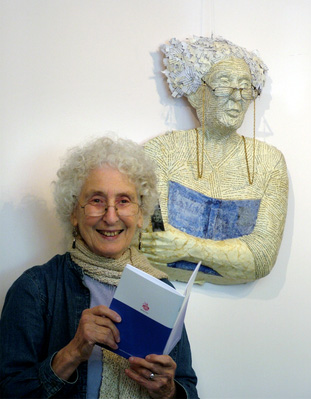
Wakan in front of sculpture by Nancy Crozier
Naomi Beth Wakan became the Inaugural Poet Laureate of Nanaimo three years ago. Wise, educated and with undeniable charm she won over the cold hard politics of city folk in a neoliberal economy. She has managed to unite the practical with the arts, offering a deeper expression of humanity.

Among Naomi's achievements are a high school poetry competition, a Nanaimo Poetry Map and Poetry in Transit. “So many people have told me how they have enjoyed reading the poetry while on the buses, and that involved a new bunch of poets too,” said Wakan. “I love to see people coming out who weren’t actually part of the poetry scene before, having the confidence to join the poetry gang and see themselves published.” (reported by Rachel Stern, Nanaimo News Bulletin, December 28)

A hundred people attended the December celebration honouring Wakan’s contribution. Many supporters of the arts listened, wrote and read testimonials that day. 


The arts are rarely given a million dollars whereas wars are purchased with trillions. Might this spell danger for life on this planet? Big questions like this can only be answered by fools and prophets.

Poetry is more than an important art form in today’s society. It is a renewable source of energy. To the point, economical and metaphorical, it begs us to think about the lives we live and what it means to be human in an age besotted with technology and money.

Poetry also offers ideals and reality within the same conversation by recording the unremarkable observations that many have been led to believe, are not important.

“For it can condense matter, / distill the essence, / purify the messy, / congeal the scattered. / Each word of a poem / can carry the weight, /of the universe within it” writes Wakan in her latest book, Bent Arm for a Pillow.

This brief observation gives me great comfort when against all the news of the day,  I need to be reminded of what I can do that will have meaning.

Wakan holds no grandiose conceit about her work. She may be exhausted before the end of the day in her 85th year, but understands that what we give is made up of what we get. In a poem from the same book she reflects on the power of words “It’s on their coattails that I ride, / and the journey fills my own pages / with a voice barely my own, / a poetry mid-wifed and nourished, / by a line of ghosts.”

The poet, like the wind or the click of a humming bird, becomes the voice of nature, as one among many voices. She came, she saw, she wrote! Surely we need more poets than conquerors.

The poet doesn’t want to manipulate organic forms for profit - she just wants nature to be itself. “We read to remind ourselves / that we already know / how life should best be lived, / but that we have,  for a moment, / forgotten.”

Of course, this kind of philosophy won’t sell pharmaceuticals or bombs, and could be seen as dangerous to a ruling ideologue. But hugely inspirational for the harried mind of humans in their rush to get through their days.

Thursday, 16 June 2016

Infinite Power - a book of poems


Image: Heroic Journey by Paul Grignon
Infinite Power, in Vickers eyes “is not a zero sum game 
but a journey / a stone thrown in a lake / circular ripples
emanating outward” and the danger of our age is that we have
lost contact with that power, made it something to possess 
like a personal bank account. In writing these poems she 
hopes for a reconnection to that sacred universal relationship.

Janet Vickers’s book of poetry, entitled Infinite Power, 
has such an accurate title for this is an important, brave and, 
indeed, powerful gathering of poems. She is on a search, a 
compelling search, that draws the reader along with her as 
she questions accepted concepts, ploughs through mankind’s 
inhumanity and even tears nature apart in her quest for a core
of hope amidst despair. “The distant bird singing,” as she puts
it. This need to give reason for continuance is evidenced in 
Vickers startling fresh and demanding metaphors and her 
piercing questions. Hope comes in the last few words—“love 
everyone, hate no-one, move to the edge.” It takes profound
insight to come to such a seemingly innocent answer.
~ Naomi Beth Wakan, inaugural Poet Laureate of Nanaimo


These poems are at turns thought-provoking, accusatory, or playful in their exploration of topics such as
climate change, extinctions, greed or incidents from her own past. The thread always running throughout
Janet's work is her commitment to honouring all that’s sacred, whether that might be in the world of nature or
in the realm of the human heart.
~ Heidi Greco

This is Janet Vickers’s second trade book of poems. Her first book, Impermanence was published in 2012, also by Ekstasis. Her poems have appeared in anthologies in Canada (Down in the Valley, Ekstasis 2004) and the UK (Refugees Welcome and The Poet’s Quest for God, Eyewear 2016), in literary journals and online magazines. Janet is active in the community on Gabriola Island where she lives with Tony, her husband of 46 years.

To order go to Ekstasis Editions

Monday, 21 May 2012

The Power of Diligence

Hanh says we are capable of going back to our best selves but we must maintain this practice of diligence.

He says there are two kinds of consciousness - the open consciousness (the living room) and store consciousness (the basement).  But the store consciousness is described also as the land where seeds lay underground that we don't pay much attention to until something happens to remind us of those seeds.

In most people's lives, there have been times when we have felt threatened, angry, victimized and in despair - not knowing where to turn next. These feelings are seeds, hidden underground, when we are happy and life is good, but when fears arise we feel those seeds lying there, and must decide whether to water them or let them dry up.

There are four aspects of diligence: first - when negative emotions haven't manifested in your mind, you don't give them a chance to manifest; second - is calming and replacing negative seeds (anger, hate, fear, despair) in your conscious mind; third - is to always invite good seeds to manifest (love, forgiveness, joy, peace, happiness); fourth - is trying to keep a good mental formation such as compassion, joy, peace, by nurturing it.

Last night it took me awhile to get to sleep, so rather than water the seeds of frustration, I lay in bed thinking about how comfortable it was listening to the rain outside.  Focusing on positive emotions I turned on the light and began reading Naomi Beth Wakan's book The Way of Haiku, marvelling at the beautiful language there and the culture that has enabled us to create poetry. Filled with gratitude I eventually went to sleep.

Yes I know that beautiful thoughts and words can't defend us against guns and bombs, but they do inspire us and other people to act on behalf of peace and justice.

Love Everyone, Hate No-one, Move To The Edge

Women are joining groups to fight back the misogynists. And here's how to do it. Don't hate or insult anyone or anything. Yes the sl...