Showing posts with label poetry. Show all posts

Monday, 27 May 2019

Evolution


Whitman, Emerson and Thoreau
died in America.

Four boys escaped Lejac and froze
to death on the lake near home.

The army in Uzbekistan executed children
as an example.

We are not really toilet trained.
We are trained to believe we are.

I have learned how to scream
with my mouth closed.


(from Infinite Power, Ekstasis 2016)

Tuesday, 7 May 2019

He calls me an intellectual


He calls me an intellectual

but I know it’s code—meaning
my mind wanders aimlessly through the forest
while he replaces the filter to the UV lamp
or pulls weeds between shrubs
notices the lapsed club membership
leafs through cookbooks for a chicken recipe
scans the Internet for flights to Toronto
sees cobwebs on the skylight which he must keep
to himself, as if


I would never notice webs created by
one or more of the seven hundred spider species
of British Columbia and search the Internet myself
for its name which accidentally takes me
to a strange image of a rat-like creature
who has a tail coming out of its chest and wonder
if it might be a lab-test rat or an entirely
new species, and whether something should be done
about that


like further research
to be informed, to have knowledge
the scientific proof, to know the facts
that escape as soon as I try to pin them down
fearing he will ask
are you sure about that
and I must confess
I am never sure about anything.

(from Infinite Power, Ekstasis 2016. Cover painting is from Paul Grignon http://www.paulgrignon.com)

Monday, 22 April 2019

Song of Praise

iv.


O garden of mosses and wave petunias
flaunty japonica in brilliant auras

O wooden bench on painted deck
occasional fleck of a resettled petal

O gardener checking tomatoes in pots
digging up lots for next year’s crops

O sunless day in September before the turning
red burning of green leaves

O socks and shoes and fleeting epochs
hydrangea bushes and bird-feather blues

everything everything O so morning
the unnamed tree with its rabbit ears

the cedars, the grasses, the finger marked glasses,
the rusty shears and later years

the melted candle on window sill
O happy pill and polymer painted palisade fractal.

(from Infinite Power, Eskasis 2016)


Sunday, 7 April 2019

Old Man in the Corner


In the dark corner of the bar 
an old man crumpled in his seat
can barely lift his glass
—each pint gets heavier
each day takes more to numb the pain.

He has given up trying to understand the source
of his grief, the reason for his expulsion
from a place, like joy, peace, or belonging.
He knows like blood coursing through his veins 
he was robbed.
Of what? His manliness? His hope?
His tribe. He has lost his tribe.
He has lost his job. And someone
has to pay.

Yes he knows about NAFTA
and the jobs that went to India
and the slick talkers in suits
cutting him loose from the plant
and he knows like the knife
in his stomach that they can’t
be hurt, can’t be touched
by anything he does.

And he can’t tell his buddies
they have cut off his balls.

So when he screams
get rid of all the others,
he means those who are not like him
and throughout his years
of becoming a man
he has become the foreigner

to his own heart.

(Infinite Power, Janet Vickers. Ekstasis 2016)

Friday, 3 August 2018

Gabriola: The Integrity and Inspiration of Art

DRUMBEG HOUSE ANNUAL STUDIO SALE
When: Sunday, August 26th 10 am - 4 pm
Where: 3085 Mander Road


This is probably the last time we will have a day when the general public will be invited to visit the Wakan 
home and studio. Naomi turns 87 this year and, while she will have books for sale on the day, all present and future sales of her books are being handled by the bookstore at Page's Marina (mail@pagesresort.com). 


Eli, too, is slowing down. Several of his large pieces will be available for silent auction at a low reserve bid, so now's a chance for you to get a "big statement" for your home, or office. If you're interested in negotiating a purchase before then, please check out the sculptures at www.eliaswakan.com 

Whether you're thinking of buying, or just want to drop by, we welcome everyone to help us celebrate our 22 
years of creativity on Gabriola. This is a free event. We will have refreshments for you to enjoy.

Naomi Beth Wakan
3085 Mander Rd
Gabriola, BC, V0R 1X7
www.naomiwakan.com
naomi@naomiwakan.com

Friday, 19 January 2018

Learn How to Write Japanese Poetry


INTRODUCTION TO WRITING JAPANESE POETRY

Learn about two time-honoured forms of Japanese poetry haiku (the poetry of the senses, probably the most difficult poetry form to write) and tanka (the longest continually written poetry form). This workshop is suitable both for poets (emerging or experienced) and non-poets. This workshop will expand your genre as writers and deepen your understanding as readers.

TIME: April 14th, 2 3:30 pm
PLACE: Nanaimo Museum, corner of Commercial Street and Museum Way
FEE: $25
TO REGISTER: C. Beryl
crone562003@yahoo.com

FACILITATOR: Naomi Beth Wakan is a personal essayist and poet. She is the Inaugural Poet Laureate of Nanaimo. She has written over fifty books including the prize-winning Haiku one breath poetry, (Heian International) and, most recently, The Way of Tanka (Shanti Arts). 

Thursday, 28 December 2017

No. 2 of a New Hierarchy of needs.

2. knowledge - in order to survive we must study what is true in nature and in our selves.

We need to know the plants that will nourish and the plants that poison. We need to know the actions that bring peace in our lives and the actions that create discomfort, fear, and pain.

Conversations to share knowledge, to teach facts, to share poetry and stories, to report on what is going on in the world are like nourishment. All creatures must have some basic knowledge. All generations need new stories.

Absolutes exist but if we never question or move beyond these absolutes we become afraid of thinking or reading or learning, in case we discover we don't know everything.

The fear that we don't know everything is what will make us willing robots for the political movements that demand we must obey and not think, and we are under threat of their control whenever we stop questioning.

Friday, 28 July 2017

Restless is the Heart of an Exile

From Ascent Aspirations Friday's Poem 

This little town holds
a contained and fragile charm
where my elsewhere-birthed spirit
learns to survive.
My sustaining friends candle it into home
though shadows shimmer in curtained corners.
The land of ancestors buried in hard-won sacred soil
calls out to my waiting bones...
I am forbidden to answer,
grieve for my moment to come
when alien soil covers restless remains
and spirit hovers between
the world that barely embraces me
and the pulsing claim of blood and ligament,
heart, spirit and tribal ties
that scream for my absorption
back into fiery particles that stoked my entity.
Wine cannot placate, bread of other fields seldom satisfies,
a communion I must re-learn.

Katherine L. Gordon
for Trump exiles from America.

Friday, 16 June 2017

Tomorrow at Gabriola Branch of VIRL

Flightpaths

The Lost Journals of Amelia Earhart 

Heidi Greco


June 17, 1:30 - 2:30 PM
Vancouver Island Regional Library, 
Gabriola Branch
575 N Rd #5, Gabriola, BC V0R 1X3
 (250) 247-7878

On the 120th anniversary of Amelia Earhart’s birth and the 80th anniversary of her disappearance, award-winning poet, Heidi Greco revitalizes what we know about the iconic aviator through uplifting and historically mesmerizing verse.

If most people were asked what they know about Amelia Earhart, they’d probably respond with something like “Wasn’t she that pilot who went missing when she tried to fly around the world?”
Although that much is true, Earhart was so much more. She was a feminist at a time when women were just beginning to make inroads towards equality. She was a best-selling author who made appearances and speeches that inspired many. In addition, she was a pacifist, a poet, a punster – the list could go on. She was ahead of her time in so many ways, right down to the no-nonsense clothes she wore (many of them fashioned after her own designs).
To this day, her disappearance is enshrouded in mystery, with many questions remaining. Was she on a secret mission, spying for her country? Was she captured by the Japanese and held in a prison camp? Or did she and her navigator simply crash and die?
The poems in this collection, presented as if written by Earhart herself, consider some of the many theories that attempt to explain her disappearance. Through logbook entries, recollections and letters, the work explores some of the various flightpaths she may have taken.
Flightpaths: The Lost Journals of Amelia Earhart slips easily from windowpane prose to lyric as Heidi Greco delivers the realities, the fantasies, the possibilities of Amelia Earhart’s last flight over the Pacific Ocean with a complex simplicity that gives us both what probably was and what might have been — building a poem/story of a life bigger than history.
Brian Brett, author of Tuco: The Parrot, The Others, and The Scattershot World
“In this unique and intriguing fictional tale, Heidi Greco convinces us that Amelia Earhart’s Lockheed 10 Electra went down near a remote Pacific island. This tragic event, and the disappearance of Amelia’s plane into the ocean, leaves the reader wondering what happened to this brave pilot who accepted the challenge of a world flight in 1937.”
— Ann Holtgren Pellegreno, Pellegreno was the first to fly a Lockheed 10 Electra around the world on the Earhart Trail. On July 2, 1967, she dropped a wreath on Howland Island.

Wednesday, 3 May 2017

Eyewear: Fortnight Prize for Best Poem Every 14 days


THE JUDGE: Dr Todd Swift, Writer-in-residence, Pembroke College, Cambridge, and Director of Eyewear.

Thursday, 29 December 2016

How a Poet Laureate Deepens the World

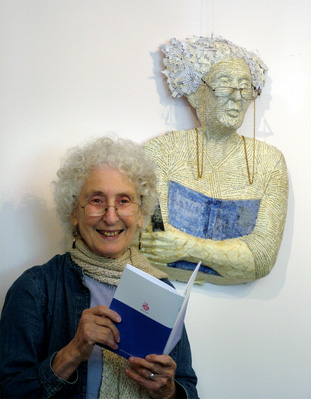
Wakan in front of sculpture by Nancy Crozier
Naomi Beth Wakan became the Inaugural Poet Laureate of Nanaimo three years ago. Wise, educated and with undeniable charm she won over the cold hard politics of city folk in a neoliberal economy. She has managed to unite the practical with the arts, offering a deeper expression of humanity.

Among Naomi's achievements are a high school poetry competition, a Nanaimo Poetry Map and Poetry in Transit. “So many people have told me how they have enjoyed reading the poetry while on the buses, and that involved a new bunch of poets too,” said Wakan. “I love to see people coming out who weren’t actually part of the poetry scene before, having the confidence to join the poetry gang and see themselves published.” (reported by Rachel Stern, Nanaimo News Bulletin, December 28)

A hundred people attended the December celebration honouring Wakan’s contribution. Many supporters of the arts listened, wrote and read testimonials that day. 


The arts are rarely given a million dollars whereas wars are purchased with trillions. Might this spell danger for life on this planet? Big questions like this can only be answered by fools and prophets.

Poetry is more than an important art form in today’s society. It is a renewable source of energy. To the point, economical and metaphorical, it begs us to think about the lives we live and what it means to be human in an age besotted with technology and money.

Poetry also offers ideals and reality within the same conversation by recording the unremarkable observations that many have been led to believe, are not important.

“For it can condense matter, / distill the essence, / purify the messy, / congeal the scattered. / Each word of a poem / can carry the weight, /of the universe within it” writes Wakan in her latest book, Bent Arm for a Pillow.

This brief observation gives me great comfort when against all the news of the day,  I need to be reminded of what I can do that will have meaning.

Wakan holds no grandiose conceit about her work. She may be exhausted before the end of the day in her 85th year, but understands that what we give is made up of what we get. In a poem from the same book she reflects on the power of words “It’s on their coattails that I ride, / and the journey fills my own pages / with a voice barely my own, / a poetry mid-wifed and nourished, / by a line of ghosts.”

The poet, like the wind or the click of a humming bird, becomes the voice of nature, as one among many voices. She came, she saw, she wrote! Surely we need more poets than conquerors.

The poet doesn’t want to manipulate organic forms for profit - she just wants nature to be itself. “We read to remind ourselves / that we already know / how life should best be lived, / but that we have,  for a moment, / forgotten.”

Of course, this kind of philosophy won’t sell pharmaceuticals or bombs, and could be seen as dangerous to a ruling ideologue. But hugely inspirational for the harried mind of humans in their rush to get through their days.

Thursday, 16 June 2016

Infinite Power - a book of poems


Image: Heroic Journey by Paul Grignon
Infinite Power, in Vickers eyes “is not a zero sum game 
but a journey / a stone thrown in a lake / circular ripples
emanating outward” and the danger of our age is that we have
lost contact with that power, made it something to possess 
like a personal bank account. In writing these poems she 
hopes for a reconnection to that sacred universal relationship.

Janet Vickers’s book of poetry, entitled Infinite Power, 
has such an accurate title for this is an important, brave and, 
indeed, powerful gathering of poems. She is on a search, a 
compelling search, that draws the reader along with her as 
she questions accepted concepts, ploughs through mankind’s 
inhumanity and even tears nature apart in her quest for a core
of hope amidst despair. “The distant bird singing,” as she puts
it. This need to give reason for continuance is evidenced in 
Vickers startling fresh and demanding metaphors and her 
piercing questions. Hope comes in the last few words—“love 
everyone, hate no-one, move to the edge.” It takes profound
insight to come to such a seemingly innocent answer.
~ Naomi Beth Wakan, inaugural Poet Laureate of Nanaimo


These poems are at turns thought-provoking, accusatory, or playful in their exploration of topics such as
climate change, extinctions, greed or incidents from her own past. The thread always running throughout
Janet's work is her commitment to honouring all that’s sacred, whether that might be in the world of nature or
in the realm of the human heart.
~ Heidi Greco

This is Janet Vickers’s second trade book of poems. Her first book, Impermanence was published in 2012, also by Ekstasis. Her poems have appeared in anthologies in Canada (Down in the Valley, Ekstasis 2004) and the UK (Refugees Welcome and The Poet’s Quest for God, Eyewear 2016), in literary journals and online magazines. Janet is active in the community on Gabriola Island where she lives with Tony, her husband of 46 years.

To order go to Ekstasis Editions

Thursday, 9 July 2015

A Small Needful Fact by Ross Gay


reposted with permission from Split This Rock Poem of the Week.

A Small Needful Fact


Is that Eric Garner worked
for some time for the Parks and Rec.
Horticultural Department, which means,
perhaps, that with his very large hands,
perhaps, in all likelihood,
he put gently into the earth
some plants which, most likely,
some of them, in all likelihood,
continue to grow, continue
to do what such plants do, like house
and feed small and necessary creatures,
like being pleasant to touch and smell,
like converting sunlight
into food, like making it easier
for us to breathe.

Ross Gay is a gardener and teacher living in Bloomington, Indiana. He is the author of the collections Against Which, Bringing the Shovel Down, and most recently The Catalogue of Unabashed Gratitude (Pitt Poetry Series, 2015). His poems have appeared in American Poetry Review, Atlanta Review, Harvard Review, Columbia: A Journal of Poetry and Art, and Margie: The American Journal of Poetry, among other places.


About Split This Rock:

cultivates, teaches, and celebrates poetry that bears witness to injustice and provokes social change. It calls poets to a greater role in public life and fosters a national network of socially engaged poets. Building the audience for poetry of provocation and witness from our home in the nation’s capital, we celebrate poetic diversity and the transformative power of the imagination.

Split This Rock explores and celebrates the many ways that poetry can act as an agent for change: reaching across differences, considering personal and social responsibility, asserting the centrality of the right to free speech, bearing witness to the diversity and complexity of human experience through language, imagining a better world.

Split This Rock is dedicated to revitalizing poetry as a living, breathing art form with profound relevance in our daily lives and struggles. Our programs integrate poetry of provocation and witness into movements for social justice and support the poets of all ages who write and perform this vital work.

The name "Split This Rock" is pulled from a line in “Big Buddy,” a poem from Langston Hughes.

Don’t you hear this hammer ring?
I’m gonna split this rock
And split it wide!
When I split this rock,
Stand by my side.


Monday, 11 August 2014

Where I am Folded I Am a Lie


Rainer Maria Rilke respectfully declines to review or criticize poetry, advising the younger Franz Xaver Kappus that "Nobody can advise you and help you, nobody. There is only one way. Go into yourself."[1]


I am too alone in the world, and yet not alone enough
to make every moment holy.
I am too tiny in this world, and not tiny enough
just to lie before you like a thing,
shrewd and secretive.
I want my own will, and I want simply to be with my will,
as it goes toward action;
and in those quiet, sometimes hardly moving times,
when something is coming near,
I want to be with those who know secret things
or else alone.
I want to be a mirror for your whole body,
and I never want to be blind, or to be too old
to hold up your heavy and swaying picture.
I want to unfold.
I don’t want to stay folded anywhere,
because where I am folded, there I am a lie.
and I want my grasp of things to be
true before you. I want to describe myself
like a painting that I looked at
closely for a long time,
like a saying that I finally understood,
like the pitcher I use every day,
like the face of my mother,
like a ship
that carried me
through the wildest storm of all.”

Rainer Maria Rilke

Without Emotions to Balance Our Fears

  We shall use our thoughts carelessly. We can imagine all sorts of cruel scandals invented by The Other. There's enough there to keep u...